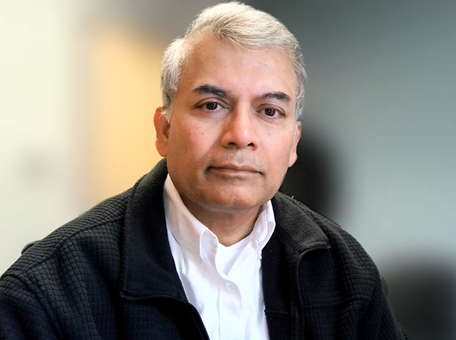
Prof. Vivekanandan Kumar is Associate Dean (Flexible Delivery) and Full Professor in Computing Science at Thompson Rivers University, Canada.
Imagine a world in which software agents embedded across your digital devices learn alongside you – teaching, playing, studying, and mentoring – sparking curiosity, challenging ethical thinking, building trust, broadening global awareness, and enriching how you live and learn. His research is centred on the design of anthropomorphic, cognified AI agents that emulate and extend human-like traits to support and enhance learning.
He earned his PhD in Computer Science from the University of Saskatchewan, Canada, graduating as the top student in 2001. He also holds a Master’s degree in Computer Applications (first rank) and a Bachelor’s degree in Physics (third rank) from India. His professional career began in 1990 as a Scientist at the Centre for Development of Advanced Computing (C-DAC) in Mumbai, India, where he later received a United Nations fellowship to train at the Learning Research and Development Center at the University of Pittsburgh, USA.
In 2001, he joined Simon Fraser University in Surrey, Canada, as an Assistant Professor, while also working as an Educational Technologist with the Asian Development Bank to help develop an online learning infrastructure and a Master’s program in Educational Technology for the Open University of Sri Lanka. From 2006 to 2008, he served as a Senior Lecturer at Massey University in Wellington, New Zealand, before returning to Canada as an Associate Professor at Athabasca University. Supported by major grants from NSERC, SSHRC, and CFI, he is an active and contributing member of the Artificial Intelligence in Education (AIED) research community. He has authored over 175 peer-reviewed publications across journals, conferences, and book chapters, with a sustained focus on advancing cognification in both human learning and machine learning. He is a Senior Member of IEEE and a member of AIED, and his broader interests include humanity-plus futures, the knowledge economy, social change through science fiction, and ICT-enabled equity, diversity, and inclusion.